
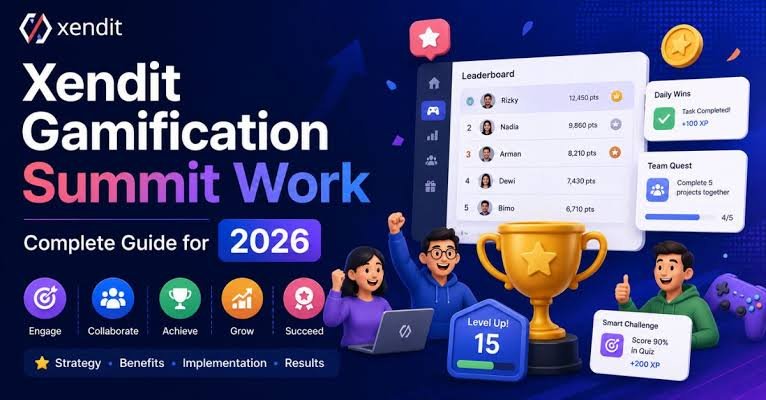
If you searched for xendit work gamificationsummit, the first thing to know is that the phrase is more ambiguous than many articles make it appear. As of September 1, 2026, there is no reliable public confirmation that “Xendit Work GamificationSummit” is the official name of a Xendit product, corporate program, conference, or employee initiative.
Table of Contents
That distinction matters because current search results give several different explanations. Some describe a supposed Xendit workplace gamification event. Others connect Xendit with ticket payments for gamification-focused conferences. Still others use the phrase more broadly to discuss employee engagement, game mechanics, fintech, and digital work culture.
What can be verified is much clearer: Xendit is a financial technology company focused on payment infrastructure, particularly for businesses operating in Southeast Asian markets. Gamification, meanwhile, is a genuine workplace and product-design concept that uses game-inspired elements such as progress indicators, challenges, feedback, achievements, and rewards.
This article separates those confirmed concepts from the claims that remain unverified.
What Is Xendit Work GamificationSummit?
The safest definition of Xendit Work GamificationSummit is that it is an emerging search phrase combining three subjects: Xendit, workplace gamification, and gamification-focused events or discussions.
It should not currently be treated as the confirmed name of an official Xendit service.
A useful way to understand the phrase is:
| Part of the phrase | What it refers to |
|---|---|
| Xendit | A payment infrastructure and fintech company |
| Work | Workplace, employee, business, or operational applications |
| Gamification | Applying selected game-design principles to non-game activities |
| GamificationSummit | A term appearing in third-party online content about gamification, events, workplace engagement, and related technology |
The confusion comes from the way third-party websites have framed the phrase. Some pages describe an organized “Xendit Work Gamification Summit” with workshops, leaderboards, employee activities, or conference sessions. Other pages interpret the same keyword as an explanation of how Xendit could process payments for event tickets.
Those are substantially different meanings.
Without primary confirmation from Xendit, details such as supposed summit speakers, schedules, internal teams, participation figures, performance improvements, or program results should not be presented as established facts.
Why Search Results for Xendit Work GamificationSummit Are Confusing
The current search landscape contains multiple competing interpretations of the keyword.
One group of articles presents Xendit Work GamificationSummit as a workplace engagement initiative. These pages discuss employee challenges, points, badges, leaderboards, recognition, productivity, and collaboration.
A second group focuses on payments. In that interpretation, Xendit provides payment infrastructure that could sit behind an event registration or ticketing system. A customer pays for admission, the payment processor handles the transaction, and the event platform manages the ticket or registration.
A third interpretation is much broader. It treats the phrase as a starting point for explaining how fintech companies could use gamification principles in areas such as employee training, customer onboarding, product adoption, or internal performance systems.
The problem is not that these applications are impossible. The problem is when hypothetical applications are written as though Xendit has publicly confirmed them.
For readers, the key distinction is therefore:
Xendit is real. Workplace gamification is real. Their combination in a formally named “Xendit Work GamificationSummit” is not currently supported by clear official public confirmation.
That is a more reliable answer than repeating detailed summit descriptions simply because they appear on multiple websites.
What Xendit Actually Does
Xendit is a fintech company that provides businesses with infrastructure for accepting payments, sending funds, and managing money movement.
The company began in Indonesia and has developed a strong presence across Southeast Asia. Its technology is designed to simplify the complexity of payment markets where customers may use far more than standard credit and debit cards.
Depending on the supported country and product, payment ecosystems in the region can involve bank transfers, cards, QR-based payments, local financial institutions, digital wallets, and other locally important methods.
This is especially relevant to American companies expanding internationally.
A U.S. company entering Southeast Asian markets cannot always assume that a checkout experience built primarily around American payment behavior will meet local customer expectations. Payment infrastructure providers such as Xendit address that problem by connecting businesses with payment methods used in the markets they serve.
Xendit also publicly discusses its corporate culture, recruitment processes, learning, trust, customer focus, and employee development. However, a company having a distinctive workplace culture is not evidence that every third-party description of an internal gamification program is accurate.
There is currently no reason to describe “GamificationSummit” as one of Xendit’s established core payment products.
How Workplace Gamification Actually Works
Workplace gamification means applying selected elements associated with games to business activities without turning the job itself into a game.
A company might use gamification to make employee training easier to follow, provide clearer progress feedback, encourage participation in learning programs, recognize achievements, or help teams visualize progress toward a defined objective.
Common mechanics include:
| Gamification element | Possible workplace purpose | Potential concern |
|---|---|---|
| Progress bars | Show advancement through training or onboarding | Can become meaningless if progress is artificial |
| Badges | Recognize specific achievements | May lose value when awarded too easily |
| Challenges | Encourage completion of defined tasks | Poorly designed challenges can distract from real work |
| Points | Provide immediate progress feedback | Employees may optimize for points rather than quality |
| Leaderboards | Show comparative performance | Can create unhealthy competition |
| Team goals | Encourage collaboration | Poor metrics can reward quantity instead of contribution |
| Levels or milestones | Structure long learning processes | Can feel manipulative if employees have little choice |
Research into workplace gamification does not support the simple idea that adding points and leaderboards automatically makes employees more productive.
Design matters.
Gamification tends to make more sense when it gives people useful feedback, a sense of progress, opportunities to develop competence, appropriate recognition, and some control over their participation.
It can work poorly when employees experience it mainly as monitoring, forced competition, pressure, or another method of controlling behavior.
This is particularly important for U.S. employers considering gamified performance systems. A fun visual layer does not fix a poorly designed incentive structure. If the underlying goal encourages the wrong behavior, gamifying it may simply make the problem more visible.
How Xendit and Gamification Could Be Connected
Although a formal Xendit Work GamificationSummit cannot currently be confirmed, there are several realistic ways the ideas behind this keyword could intersect.
The first is workplace learning. A technology company could use challenges, milestones, progress tracking, collaborative exercises, or achievement systems during employee training. Xendit could theoretically use such methods like any other organization, but specific implementations should not be attributed to the company without evidence.
The second possibility is event payments. If a gamification conference or business event sells tickets in a market supported by Xendit, its organizers could potentially integrate suitable Xendit payment services into their registration or checkout system. In that situation, Xendit would be payment infrastructure, not the gamification system itself.
The third connection is product gamification. Fintech applications can use progress indicators, onboarding milestones, educational prompts, achievements, or other behavioral design techniques. Again, that does not prove that Xendit operates a product called GamificationSummit.
These three scenarios explain why search results around the keyword can look so different.
For a U.S. reader, the distinction is useful. If your interest is employee engagement, you are researching workplace gamification. If your interest is event ticket checkout in Southeast Asia, you are researching Xendit as payment infrastructure. Those are separate problems that should not be combined simply because one unusual keyword connects them.
Read More: OnlyWorkMoods com Review 2026: What It Is, Is It Legit, and Is It Safe?
What Businesses Can Learn From the Gamification Concept
The practical value of the topic lies less in an unverified summit story and more in understanding how responsible gamification can be designed.
A workplace gamification project should begin with a business problem rather than with points, badges, or prizes.
For example, imagine an organization wants more employees to complete cybersecurity training on time. The objective is not “make cybersecurity fun.” The actual objective is improving timely training completion and understanding.
The organization could divide the program into clear learning milestones, show participants their progress, provide immediate feedback after exercises, recognize successful completion, and offer optional team challenges.
That approach is very different from creating a company-wide leaderboard showing which employee completed the most activities.
Good workplace gamification generally needs several qualities.
A clear objective: The company should know exactly which behavior or outcome it wants to improve.
Meaningful progress: Employees should be able to understand where they are, what comes next, and why completing the activity matters.
Fair rules: Participants need to understand how achievements, points, or rewards are calculated.
Employee autonomy: Systems should avoid making a supposedly entertaining experience feel like mandatory surveillance.
Useful feedback: Gamification works better when feedback helps participants improve rather than merely assigning them a rank.
Balanced measurement: Quantity should not automatically be treated as quality.
A limited pilot: Organizations can test a small program before deploying it across an entire workforce.
Most importantly, companies should measure the business outcome rather than celebrating participation numbers alone. A training program generating thousands of points means little if employees learned nothing useful.
How to Evaluate Claims About Xendit Work GamificationSummit
Readers should be careful when researching this keyword because repeating information across multiple websites does not automatically turn the information into a verified fact.
Start by separating primary information from third-party interpretation.
For claims specifically about Xendit, look for confirmation from Xendit’s official company communications, documentation, careers material, or direct public statements.
Pay particular attention to detailed claims involving:
- named speakers or organizers;
- exact dates and event schedules;
- internal Xendit teams;
- employee participation numbers;
- productivity increases;
- percentage improvements;
- financial results;
- supposed executive statements;
- specific pilot programs or company-wide rollouts.
Precise numbers can make an article appear authoritative even when its underlying evidence is weak. If a website says an internal gamification project increased performance by an exact percentage but provides no credible primary confirmation, that figure should not be repeated as fact.
The same caution applies to first-person narratives. A third-party article written as “we created this program at Xendit” is not automatically an official company account.
For readers trying to understand the topic rather than chase the keyword, the simplest rule is useful: verify the Xendit claim independently before treating the gamification story as company history.
Why the Topic Matters for U.S. Companies
The keyword has an international angle that may be especially relevant to American startups, software companies, event organizers, and digital businesses.
First, Xendit represents the larger challenge of localizing payments when expanding beyond the United States. Businesses entering Southeast Asia need to understand that customer payment habits, financial institutions, regulations, currencies, and payment methods vary by country.
Second, gamification represents a broader challenge in digital employee and customer engagement. Distributed teams and online products often need clear feedback, progress visibility, recognition, and strong onboarding experiences.
The important lesson is not that every company needs a “gamification summit.”
Instead, organizations should match technology to a clearly defined problem.
A U.S. business expanding payment operations into supported Asian markets might investigate Xendit because of its payment infrastructure. An HR team seeking better training completion might investigate gamification research. An event organizer might need both an engagement strategy and a payment provider.
Those needs can overlap, but they remain separate systems with separate objectives.
Frequently Asked Questions
1. What is Xendit Work GamificationSummit?
Xendit Work GamificationSummit is an online search phrase associated with Xendit, workplace gamification, and gamification-related event content. There is currently no reliable public confirmation that it is the official name of a Xendit product or corporate program.
2. Is Xendit Work GamificationSummit a real Xendit event?
No official public confirmation establishing it as a formally named Xendit event was identified as of September 1, 2026. Third-party websites describing a specific summit should therefore be treated cautiously.
3. What does Xendit do?
Xendit provides payment infrastructure for businesses, with a strong focus on Southeast Asian markets. Its services support businesses dealing with different local payment and money-movement requirements.
4. Does Xendit provide workplace gamification software?
There is no reliable public confirmation that “Xendit Work GamificationSummit” is a workplace gamification software product offered by Xendit.
5. Can Xendit be used to process payments for events?
Xendit payment infrastructure can potentially be integrated into suitable commerce, registration, or ticketing systems where its products and supported markets meet the organizer’s requirements. That does not mean every website using the term “GamificationSummit” has an official partnership with Xendit.
6. Does gamification improve employee engagement?
It can, but results depend heavily on design and context. Useful feedback, meaningful goals, recognition, development, and voluntary participation can support engagement, while excessive competition or controlling systems may have negative effects.
7. Why are there different explanations of Xendit Work GamificationSummit online?
The keyword appears to have developed multiple interpretations. Some pages describe workplace gamification, while others discuss Xendit payments for event ticketing. This is why readers should distinguish confirmed Xendit information from third-party explanations.
Conclusion
Xendit Work GamificationSummit is best understood as an ambiguous online phrase rather than a clearly verified official Xendit product or event. Xendit itself is an established payment infrastructure company with significant relevance to businesses operating in Southeast Asian markets. Workplace gamification is also a legitimate business concept with applications in training, onboarding, recognition, learning, and employee engagement.
What remains unconfirmed is the detailed story sometimes presented online about a formally organized Xendit Gamification Summit, its speakers, employee programs, performance results, or company-wide gamification framework.
For businesses, the useful takeaway is straightforward: separate the technologies and concepts. Evaluate Xendit based on its documented payment capabilities, and evaluate workplace gamification based on the problem you want to solve, employee experience, measurable outcomes, and responsible design.
Because information around this keyword is still inconsistent, readers researching future developments should prioritize verified Xendit announcements and documented company information before treating new claims as established facts.

