
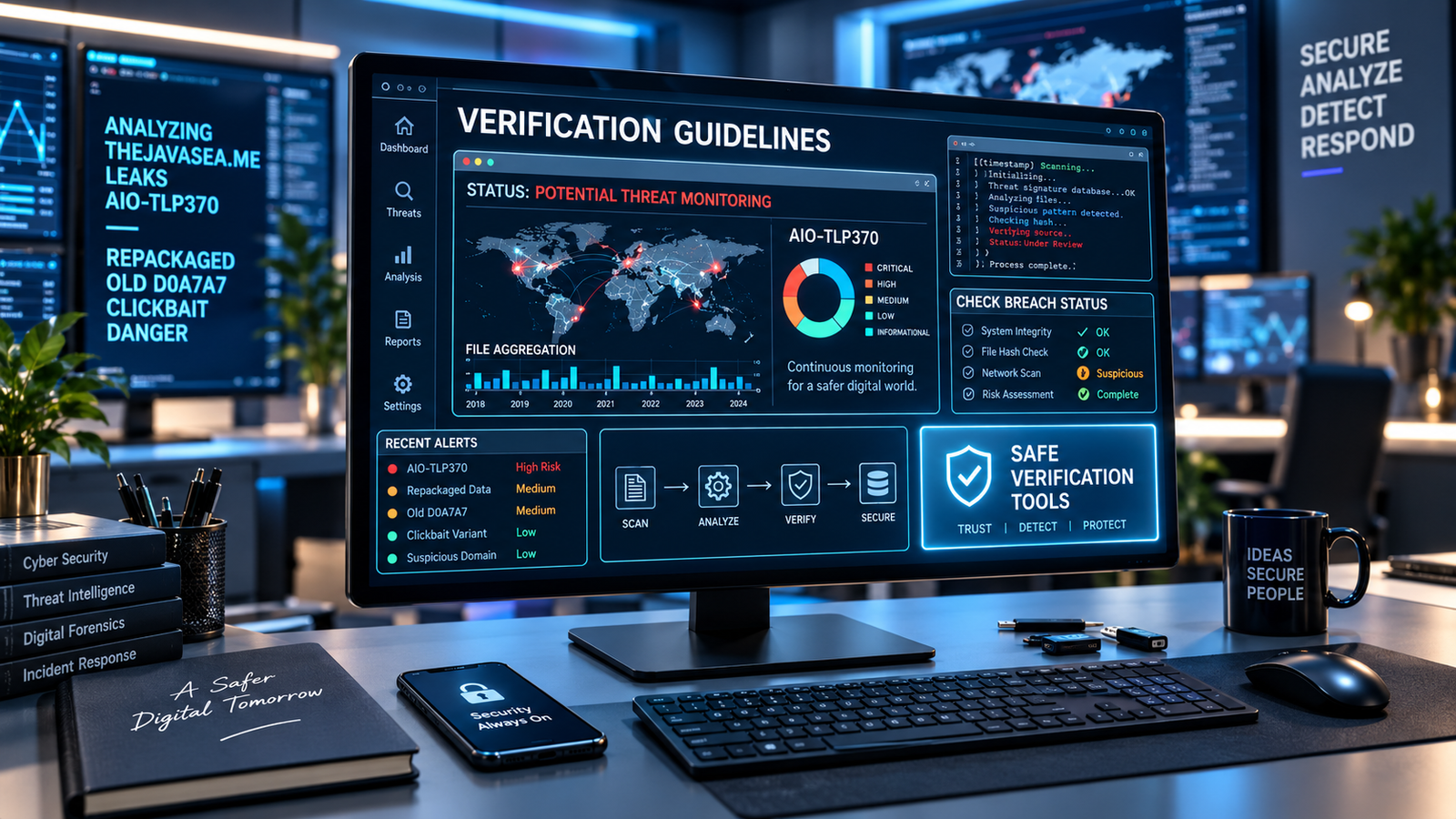
The phrase “thejavasea.me leaks aio-tlp370” has started appearing in search results connected with claims about leaked or redistributed digital material. The name sounds like a formal cybersecurity incident, but the available evidence does not support treating it that way.
As of September 22, 2026, AIO-TLP370 is best described as an unverified leak-related identifier or archive label associated online with TheJavaSea.me. There is no reliable public confirmation establishing AIO-TLP370 as the official name of a newly discovered standalone data breach, identifying a verified victim organization, or proving a specific record count.
The safest response is therefore not to search for or download the material. People worried about their own data should instead protect their accounts, check legitimate breach notifications, and watch for signs of identity theft or account takeover.
What Is TheJavaSea.me Leaks AIO-TLP370?
TheJavaSea.me leaks AIO-TLP370 appears to refer to an online leak-related package, archive, post, or identifier, but its exact contents and origin have not been independently confirmed.
Several recent websites discuss the term, yet their descriptions do not fully agree. Some describe AIO-TLP370 as a bundle of data. Others call it an archive or collection of digital files. Some make more specific claims about credentials, source code, private information, or other material without providing enough authoritative evidence to verify those claims.
That disagreement is important.
A file name, forum post, archive label, or search keyword cannot by itself prove that a new data breach occurred. It also cannot prove that files are authentic, current, complete, or connected to the organization or person suggested by their names.
For readers searching because they are worried about personal exposure, the key point is simple: the existence of the AIO-TLP370 name does not prove that your information has been compromised.
| Question | What can currently be said |
|---|---|
| Does the AIO-TLP370 term exist online? | Yes, it appears in recent online discussions and articles. |
| Is it a confirmed standalone data breach? | Reliable public confirmation has not been established. |
| Is there a confirmed victim organization? | No authoritative victim organization has been identified publicly. |
| Is there a verified number of affected people? | No reliable public total has been established. |
| Are the exact contents confirmed? | No independently verified inventory is publicly established. |
| Is “TLP370” an official cybersecurity classification? | No. |
| Should people download the files to investigate? | No. Unknown leak archives can create security, privacy, and legal risks. |
What Does the AIO-TLP370 Name Mean?
The name can easily sound more official than it actually is.
AIO is commonly used in technology communities as shorthand for “All-In-One.” This may suggest a bundled collection of files, tools, data, or resources. However, there is no authoritative documentation confirming that “All-In-One” is definitely what AIO means in this particular identifier.
The meaning of “370” is also unclear. It could function as a sequence number, release number, archive number, version-style label, or internal identifier. Presenting any one explanation as confirmed would go beyond the available evidence.
The most important part to clarify is TLP.
In professional cybersecurity, TLP normally refers to the Traffic Light Protocol, a system maintained by the Forum of Incident Response and Security Teams, known as FIRST. It helps security professionals understand how widely information may be shared.
The legitimate Traffic Light Protocol uses these labels: TLP, TLP, TLP, and TLP.
TLP370 is not an official Traffic Light Protocol designation.
Therefore, readers should not assume that the letters “TLP” in AIO-TLP370 give the package an official security classification or prove that it came from a cybersecurity organization.
Is AIO-TLP370 a Real Data Breach?
There is an important difference between a leak-related archive existing online and a verified new data breach having occurred.
A confirmed data breach normally has evidence that can be checked. This might include an announcement from the affected company, regulatory notification, government information, a forensic investigation, or credible reporting based on identifiable sources.
That type of evidence has not publicly established AIO-TLP370 as a distinct, confirmed breach.
This does not prove that every file associated with the name is fake. It simply means that claims about the archive’s origin, contents, victims, scale, and authenticity should not be treated as established facts.
Readers should be especially cautious with articles making precise claims such as a specific number of leaked records, exact file sizes, lists of supposedly compromised companies, detailed categories of private information, or claims that millions of people were affected when no authoritative evidence is provided.
A common problem with leak stories is repetition without verification. One website publishes an unsupported number, another repeats it, and eventually the claim can appear well established simply because many pages contain the same wording.
Repetition is not independent confirmation.
For AIO-TLP370, the responsible description remains narrower: it is an online identifier associated with alleged leaked or redistributed material whose exact contents and breach status remain insufficiently verified.
Why Can Downloading AIO-TLP370 Be Risky?
Trying to download an unknown leak archive simply to see what is inside can create more problems than it solves.
Unknown files may contain malware, credential-stealing software, malicious scripts, misleading installers, or files designed to exploit software weaknesses. Even an archive that appears to contain ordinary documents can include executable files or disguised content.
There are also privacy and legal concerns. A leak may contain information that was obtained or distributed without authorization. Copying, sharing, publishing, or using stolen data can create serious ethical and legal problems depending on what the files contain and how they were obtained.
The risk is especially high when unknown material involves passwords, financial information, personal records, proprietary business files, or private media.
Downloading the package also does not provide a reliable way to determine whether your own information has been exposed. A person could open a dangerous file only to discover that the archive is fake, outdated, incomplete, mislabeled, or unrelated to them.
For most users, investigating the archive itself provides little benefit.
What Should You Do If You Are Worried About the Leak?
If you searched thejavasea.me leaks aio-tlp370 because you are concerned about your email address, password, financial information, or identity, focus on protecting your accounts rather than finding the alleged files.
- Do not download unknown leak archives. You do not need a copy of leaked material to protect yourself.
- Change passwords that may have been reused. Start with email, banking, payment, cloud-storage, social-media, and work accounts. Each important account should have a different password.
- Use a password manager. It can make unique passwords much easier to create and manage.
- Turn on multi-factor or two-factor authentication. Where possible, use stronger phishing-resistant options such as passkeys or hardware security keys.
- Check your important accounts for unusual activity. Look for unfamiliar logins, password-reset messages, changed recovery information, unauthorized purchases, or security alerts.
- Use a reputable breach-notification service. This is safer than searching through leaked databases yourself.
- Watch your financial identity when sensitive information is confirmed exposed. For U.S. consumers, a credit freeze or fraud alert can provide additional protection when identity information may have been compromised.
If you receive an official breach notice from a company you use, follow the instructions from that company while independently confirming that the message is genuine. Criminals often use widely discussed data breaches as material for phishing emails.
What If You Already Downloaded or Opened a Suspicious File?
Opening an unknown file does not automatically mean your computer is infected, but it deserves attention.
Stop opening additional files from the archive. If an unknown program or executable was launched, disconnecting the affected computer from unnecessary network access can help limit further activity while you investigate.
Run an updated security or antivirus scan and make sure the operating system, browser, and security software are fully updated.
If you entered a password after opening a suspicious program or page, change that password from a different, trusted device. Change it anywhere else you reused it.
Also review your email account carefully. Email access is particularly valuable to attackers because password-reset messages for many other services often arrive there.
For a company-owned computer, contact the organization’s IT or security team instead of attempting to investigate the suspected malware yourself. Business security teams may need logs, file information, and other evidence to understand what happened.
Do not upload suspicious leaked files to public services if doing so could expose another person’s private or confidential information.
How Can You Tell Whether a Leak Claim Is Credible?
A dramatic headline should not be treated as evidence by itself.
A stronger leak report normally identifies who confirmed the incident, when it occurred, what systems were affected, what types of information were involved, and what affected users should do.
Official statements from affected organizations, government agencies, regulators, and established cybersecurity researchers usually carry more weight than anonymous posts or websites that simply repeat another article.
Be cautious when an article makes highly specific claims but cannot explain where those facts came from.
For AIO-TLP370, several warning signs make caution especially appropriate: competing descriptions of what the identifier represents, no established victim organization, no authoritative record count, and confusion between the package label and the legitimate Traffic Light Protocol.
For U.S. readers, the Federal Trade Commission provides established guidance for dealing with identity theft and confirmed data breaches. The U.S. Cybersecurity and Infrastructure Security Agency also recommends stronger authentication, including multi-factor authentication, to reduce the damage that stolen passwords can cause.
Those protective measures remain useful regardless of whether AIO-TLP370 is eventually proven authentic, mislabeled, repackaged, or entirely different from the claims circulating around it.
Read More: Troozer Com Explained: What the Website Is, How It Works, and What to Know
FAQs About TheJavaSea.me Leaks AIO-TLP370
What is TheJavaSea.me leaks AIO-TLP370?
It is an online term associated with an alleged leak-related archive, package, or collection. Its exact contents, origin, scale, and status as a distinct data breach have not been authoritatively confirmed.
Is AIO-TLP370 a confirmed cybersecurity breach?
No reliable public evidence currently establishes AIO-TLP370 as the official name of a confirmed standalone breach involving a verified victim organization.
What does AIO mean in AIO-TLP370?
AIO commonly means “All-In-One” in technology contexts. However, that interpretation has not been authoritatively confirmed for this specific identifier.
Does TLP370 belong to the Traffic Light Protocol?
No. The official Traffic Light Protocol uses TLP, TLP, TLP, and TLP. TLP370 is not an official TLP classification.
Is it safe to download AIO-TLP370?
Downloading unknown leak-related files is not recommended. Files can be malicious, incorrectly labeled, unauthorized, or unsafe to open.
How can I find out if my information was leaked?
Use legitimate breach notifications, account-security alerts, and reputable breach-checking services rather than downloading leaked databases. Also review important accounts for unfamiliar activity.
What should I do if my password was exposed?
Change the affected password immediately, change it anywhere else it was reused, use a unique replacement, and enable multi-factor authentication. A password manager can make unique credentials easier to maintain.
Final Takeaway
The main fact readers should remember about thejavasea.me leaks aio-tlp370 is that a technical-looking name does not prove a technical event.
As of September 22, 2026, reliable public evidence does not establish AIO-TLP370 as the official name of a confirmed standalone data breach, verify an affected organization, establish an exact victim count, or confirm a complete inventory of its contents.
What can be confirmed is that TLP370 is not an official Traffic Light Protocol classification.
If you are worried about personal exposure, avoid chasing unknown files. Protect your email and financial accounts, replace reused passwords, turn on stronger authentication, monitor unusual activity, and follow legitimate identity-protection guidance if sensitive information is confirmed compromised.
When new claims appear, look for confirmation from the affected organization, recognized cybersecurity authorities, or other accountable sources before treating them as fact.

