
Searching for Droven.io enterprise tech innovation can be confusing because the phrase sounds like the name of a software platform or enterprise technology service. Based on Droven.io’s current public website, however, the clearer interpretation is different: Droven.io presents itself primarily as an editorial technology hub covering artificial intelligence, digital transformation, software, cybersecurity, analytics, automation, and the future of enterprise technology.
Table of Contents
That distinction matters. The current public site does not present “enterprise tech innovation” as a clearly defined SaaS product with a dashboard, subscription plan, or enterprise deployment package. Instead, the phrase describes the broader technology themes explored through Droven.io’s articles and category pages.
For U.S. business owners, IT leaders, developers, operations teams, and technology buyers, the practical value is therefore informational: using the content to understand emerging technologies, identify relevant business use cases, and ask better questions before selecting actual enterprise products or vendors.
What Does Droven.io Enterprise Tech Innovation Actually Mean?
In practical terms, Droven.io enterprise tech innovation refers to the site’s coverage of technologies and business practices that organizations can use to modernize operations.
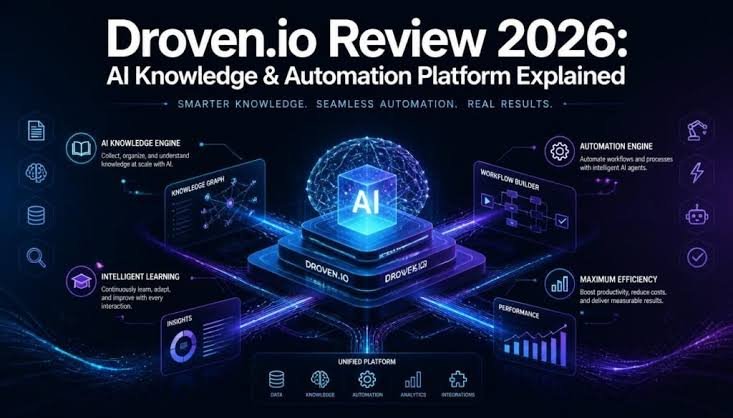
Droven.io currently describes itself as a source of insights into AI, technology, digital transformation, innovation, and the future of enterprise technology. Its public navigation separates this coverage into areas including artificial intelligence, AI tools and applications, generative AI, AI automation, information technology, cybersecurity and data privacy, software development, cloud computing, digital transformation, business processes, and big data and analytics.
This means readers should avoid interpreting Droven.io as one technology that performs all of these functions.
AI, cloud infrastructure, cybersecurity, automation, analytics, and software development are separate technology disciplines. Enterprise innovation happens when organizations connect appropriate technologies to clearly defined business problems.
A retailer might use machine learning for demand forecasting. A manufacturer could combine production data with predictive maintenance systems. A financial institution might prioritize identity security, fraud analytics, and AI governance. A software company could invest in cloud infrastructure, automated testing, and AI-assisted development.
All of these are examples of enterprise technology innovation, but they require different architectures, vendors, skills, budgets, and risk controls.
What Technology Areas Does Droven.io Cover?
Droven.io’s current editorial structure shows that its enterprise-related coverage extends across several connected technology categories rather than one narrow field.
| Technology area | Typical enterprise question |
|---|---|
| Artificial intelligence | Where can AI improve decisions, productivity, or customer experiences? |
| Business automation | Which repetitive workflows can be automated safely? |
| Generative AI | Where can language, image, or code-generation systems create measurable value? |
| Cloud computing | How should applications, storage, and computing resources be scaled? |
| Cybersecurity | How can digital assets, identities, networks, and data be protected? |
| Big data and analytics | How can organizations turn operational data into useful decisions? |
| Digital transformation | How should technology changes connect to wider business processes? |
| Software development | How can organizations build and maintain reliable digital products? |
| Future of work | How will automation and emerging tools change skills and workflows? |
Artificial intelligence and automation
AI is one of the strongest themes on the platform. Droven.io currently publishes material concerning AI applications, generative AI, business use cases, automation, productivity, and AI-supported workflows.
For enterprises, however, the useful question is rarely simply, “Should we use AI?”
A stronger question is: Which specific workflow has enough cost, delay, repetition, or decision complexity to justify AI?
Possible applications include customer-service assistance, document classification, demand forecasting, internal knowledge retrieval, anomaly detection, software development support, marketing operations, and workflow routing.
Cloud infrastructure
Droven.io also maintains cloud-computing coverage involving major cloud platforms, hybrid and multi-cloud environments, security, scalability, and business adoption. Its current cloud section includes enterprise-focused subjects such as hybrid and multi-cloud security.
Cloud technology matters because many AI, analytics, collaboration, software, and automation projects depend on scalable computing and data infrastructure.
Cybersecurity and privacy
Enterprise innovation cannot be separated from cybersecurity.
Droven.io’s cybersecurity category currently includes topics involving enterprise connectivity, cloud security, phishing, certificates, third-party risk, network monitoring, and other security concerns.
That is particularly relevant for U.S. organizations because technology projects increasingly need to be assessed through the same enterprise-risk process as financial, operational, and legal risks.
Why This Matters to U.S. Businesses
The most useful way for American businesses to approach enterprise technology innovation is to start with business outcomes rather than technology trends.
Buying a new AI system simply because AI adoption is increasing is not a strategy. Neither is moving an application to the cloud solely because competitors have done so.
A technology initiative becomes strategically useful when there is a clear relationship between the investment and an operational problem.
Consider a company processing thousands of customer requests. Management might initially believe that it needs an AI chatbot. After reviewing the workflow, however, the company could discover that most delays come from poor routing between departments rather than from answering customer questions.
In that case, workflow automation and better systems integration might produce more value than a chatbot.
The same principle applies to analytics. A company may invest in an advanced predictive model but discover that its underlying customer, inventory, or operational data is incomplete. Improving data quality could therefore be more valuable than purchasing another analytics platform.
This problem-first approach is one of the most important distinctions between genuine technology modernization and simply collecting new software.
For readers using Droven.io or similar technology publications, the content can help establish the vocabulary and concepts needed to investigate these decisions. It should not replace technical due diligence, vendor evaluation, security review, or regulatory advice.
From Technology Trends to a Practical Enterprise Innovation Strategy
Enterprise innovation works better as a controlled process than as a sequence of disconnected technology purchases.
A practical framework can begin with six questions.
What problem are we trying to solve?
Define the operational issue first. It might involve processing time, infrastructure cost, customer churn, security exposure, forecasting accuracy, software-development delays, or manual administrative work.
What measurable outcome would make the project worthwhile?
Choose metrics before implementation. Relevant measures could include processing time, error rates, cost per transaction, system availability, customer-resolution time, conversion rate, forecast accuracy, or employee hours saved.
Is the underlying data ready?
Modern AI and analytics depend heavily on data quality. Organizations should understand where data comes from, who owns it, how accurate it is, who can access it, and whether it can legally and securely be used for the intended purpose.
How will the technology connect with existing systems?
Integration is often more important than impressive standalone features. Enterprises typically operate combinations of legacy applications, cloud platforms, databases, identity systems, APIs, and third-party services.
A tool that performs well in a demonstration but cannot integrate reliably with the existing environment may create more work rather than less.
What new risks does the project introduce?
Security, privacy, incorrect AI output, vendor dependency, service outages, unauthorized access, compliance obligations, and employee adoption can all affect the real value of a technology project.
Should the organization pilot before scaling?
For many innovations, a controlled pilot provides better evidence than a company-wide rollout.
A useful pilot has a specific workflow, defined users, measurable success criteria, clear security controls, and a planned review date. If the results are weak, the organization can modify or stop the project before larger costs accumulate.
Mher Lesen: GlaadVoice.com Explained: What It Is, Who Runs It and Can UK Readers Trust It?
AI Innovation Requires Governance, Not Just Better Models
Artificial intelligence deserves special attention because enterprise AI decisions increasingly involve questions about reliability, security, privacy, human oversight, and organizational risk.
For U.S. organizations, the National Institute of Standards and Technology provides an important reference point through its AI Risk Management Framework. NIST describes the framework as a voluntary resource for helping organizations manage AI risks, and it also maintains specific guidance addressing generative AI. As of 2026, NIST is continuing work on updates and additional AI risk-management profiles.
This reinforces an important lesson for enterprise innovation: the strongest AI model is not automatically the strongest enterprise solution.
Organizations may also need to evaluate:
- Security and access controls
- Accuracy and reliability
- Data handling
- Human review requirements
- Integration with existing systems
- Monitoring and auditability
- Vendor stability
- Model and infrastructure costs
- Business continuity
- Legal and regulatory requirements
An AI system that performs impressively in testing can still be unsuitable if employees cannot trust its outputs, sensitive information is poorly controlled, or the application cannot be monitored after deployment.
Enterprise AI should therefore be treated as an operational system with governance requirements, not simply as an experimental tool.
Cloud, Cybersecurity, and Data Are Part of the Same Innovation Story
One weakness in many discussions of enterprise technology is treating AI, cybersecurity, cloud computing, and analytics as separate conversations.
In real organizations, they are closely connected.
An AI application may run on cloud infrastructure. It may retrieve information from enterprise databases. Employees need identities and permissions to access it. Its APIs require protection. Data may pass between third-party services. Outputs may influence business decisions.
Each connection creates both capability and risk.
Droven.io’s category structure reflects this overlap by covering cloud computing, cybersecurity, data analytics, digital transformation, and AI business processes alongside its broader AI material.
For U.S. enterprises, cybersecurity should be considered during technology selection rather than added after deployment.
NIST’s Cybersecurity Framework 2.0 is designed for organizations of different sizes, industries, and maturity levels to understand and manage cybersecurity risk. In March 2026, NIST also published guidance specifically connecting cybersecurity, enterprise risk management, and workforce management.
The practical implication is simple: innovation decisions belong in the broader enterprise-risk conversation.
A technology project can improve productivity while simultaneously increasing dependence on an external provider. A cloud migration can improve scalability while changing identity, configuration, and data-governance requirements. An AI assistant can accelerate work while creating new questions about confidential information and output verification.
Strong innovation strategies evaluate both sides.
Is Droven.io a Software Platform or an Information Website?
Based on the current public Droven.io site, it is more accurate to describe Droven.io as an editorial or information platform than as an enterprise software product.
The site presents articles, technology categories, reviews, guides, and editorial content. It describes itself as providing insights related to artificial intelligence, digital transformation, and enterprise technology.
This clarification is important because search results contain third-party pages giving substantially different descriptions of Droven.io. Some characterize it as an automation product, digital-services company, or enterprise technology provider, while others identify it as an editorial knowledge platform.
Readers should therefore distinguish between claims made on unrelated websites and what the current official domain actually presents.
There is no need to assume that every phrase containing “Droven.io” represents a named product.
Terms such as “Droven.io AI for business,” “Droven.io cloud computing,” or “Droven.io enterprise tech innovation” can instead describe content themes associated with the site.
Unless Droven.io publicly announces a specific software product or service, it would be misleading to assign it features, pricing plans, integrations, customers, certifications, performance statistics, or enterprise capabilities that cannot be verified.
How to Use Droven.io Research Responsibly
Droven.io can be treated as a starting point for learning about technology categories and understanding terminology.
A business reader researching generative AI, for example, might first use an explainer to understand concepts such as large language models, AI agents, workflow automation, and enterprise integration.
The next step should be deeper verification.
For an actual purchasing decision, compare claims with documentation from technology vendors. For cybersecurity practices, consult recognized security frameworks and qualified professionals. For legal or regulatory questions, use the relevant government authority or professional advice. For technology performance claims, look for testing methodology rather than relying on marketing statements.
This approach is especially important in fast-moving areas such as AI because features, model capabilities, prices, security controls, and regulations can change quickly.
Readers should also check article publication dates. A technical explanation may remain useful for years, but a comparison of software features or pricing can become outdated much faster.
The best way to use an editorial technology platform is therefore not to accept every article as a final answer. Use it to understand the subject, identify the right questions, and then verify decision-critical details with primary sources.
Frequently Asked Questions
1. What is Droven.io enterprise tech innovation?
It refers to Droven.io’s editorial coverage of enterprise-related technologies such as artificial intelligence, automation, cloud computing, cybersecurity, analytics, software development, and digital transformation. The phrase does not currently appear to represent a clearly defined Droven.io software product.
2. Is Droven.io an enterprise software company?
Based on its current public website, Droven.io is best understood as an editorial technology platform. It publishes technology content rather than presenting a clearly documented enterprise SaaS product.
3. What topics does Droven.io cover?
Its current categories include AI, generative AI, AI tools, automation, cybersecurity, cloud computing, software development, digital transformation, big data and analytics, technology reviews, and future-of-work topics.
4. Does Droven.io provide AI automation tools?
The current public site contains content about AI and automation, but publicly available information does not establish that Droven.io itself provides a dedicated AI automation software product. It would be misleading to claim specific product capabilities without reliable confirmation.
5. How can U.S. businesses use Droven.io?
Businesses can use the site as an educational starting point when researching AI, cloud systems, cybersecurity, automation, analytics, and other technology categories before conducting deeper vendor and technical evaluation.
6. What should companies consider before adopting enterprise AI?
They should define the business problem, assess data readiness, evaluate security and privacy risks, establish human oversight, confirm integration requirements, identify measurable outcomes, and test the solution before large-scale deployment.
7. Is Droven.io enough for making an enterprise technology purchase?
No single editorial website should be the sole basis for a major technology purchase. Verify product capabilities, security, pricing, contracts, compliance requirements, integrations, and support directly with appropriate primary sources and specialists.
Conclusion
Droven.io enterprise tech innovation is best understood as a technology-content theme rather than the name of a confirmed all-in-one enterprise software platform. Droven.io currently positions itself around editorial coverage of artificial intelligence, automation, digital transformation, cybersecurity, cloud computing, analytics, software development, and emerging technology.
For U.S. organizations, the useful lesson goes beyond Droven.io itself. Enterprise innovation succeeds when businesses connect technology to a specific problem, prepare their data and infrastructure, evaluate security and operational risks, measure results, and scale only when the evidence supports doing so.
Use technology publications to build understanding and discover possibilities, but verify decision-critical claims through primary documentation and authoritative guidance before committing money, sensitive data, or core business processes.

