
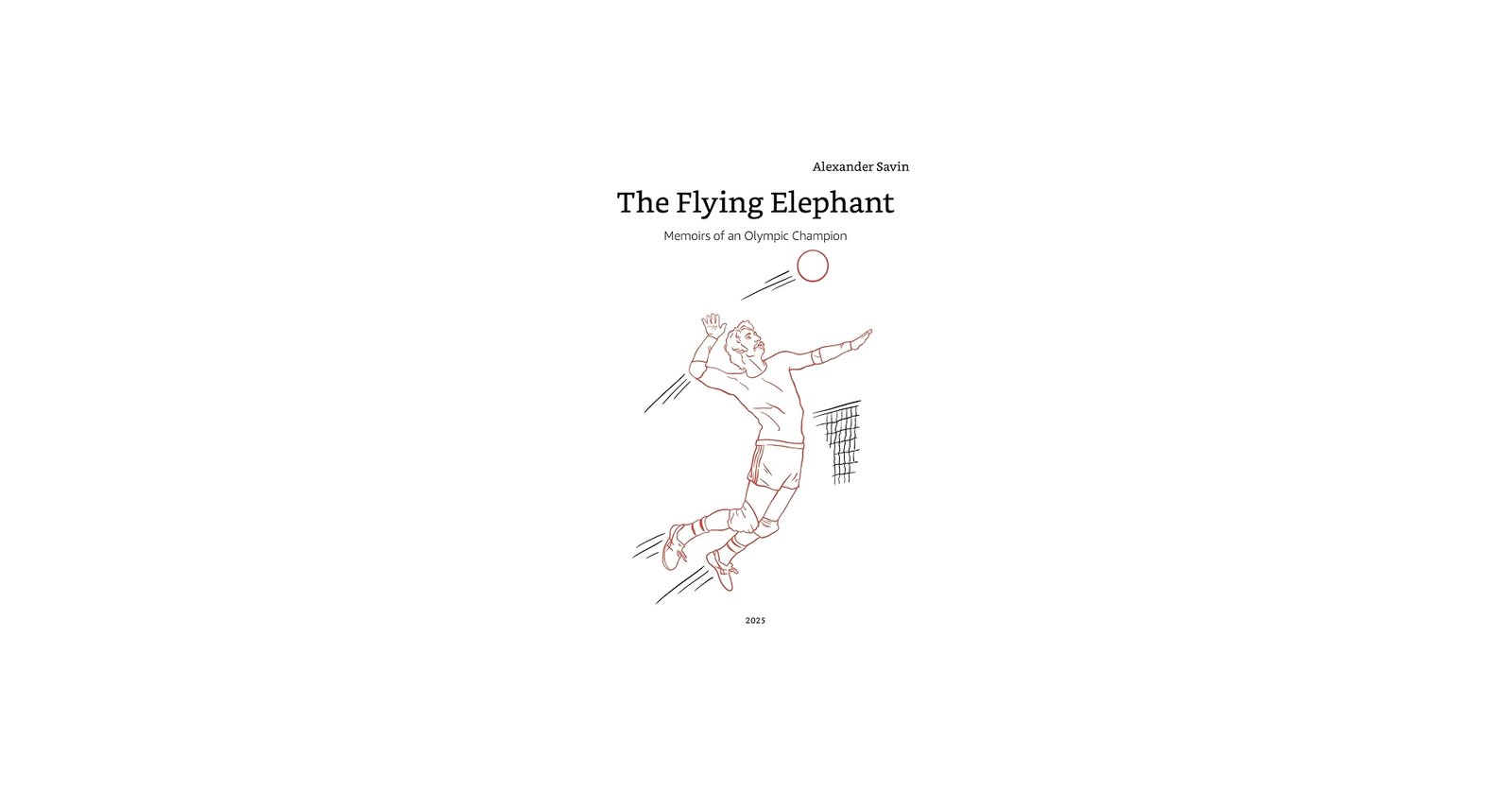
The Flying Elephant: Memoirs of an Olympic Champion is the English-language sports memoir of Alexander Savin, the Soviet volleyball great who won Olympic silver in 1976 and Olympic gold in 1980. The Kindle edition gives English-speaking readers a first-person look at elite volleyball, Soviet sports culture, major international competitions, teammates, training, and the experiences behind Savin’s long career.
Table of Contents
For U.S. readers searching for The Flying Elephant Memoirs of an Olympic Champion Kindle Edition Alexander Savin, the most important point is simple: this is a volleyball autobiography, not a fictional book with a similar title. It is especially relevant to volleyball fans, Olympic-history readers, coaches, athletes, and anyone interested in what top-level sport looked like during the Soviet era.
Current edition information describes the English Kindle version as a substantial book with a reported print length of 514 pages and more than 240 photographs. Because Amazon pricing, regional availability, and Kindle Unlimited participation can change, those details should be checked on the current U.S. Kindle listing before purchasing.
| Book detail | Information |
|---|---|
| Full title | The Flying Elephant: Memoirs of an Olympic Champion |
| Author | Alexander Savin |
| Main subject | Volleyball, Olympic competition, and Savin’s life in elite sport |
| Format | English Kindle edition |
| Reported publication date | October 26, 2025 |
| Reported print length | 514 pages |
| Photographs | More than 240 reported |
| Olympic medals | Silver in 1976, gold in 1980 |
| Hall of Fame | International Volleyball Hall of Fame, 2010 |
| Amazon identifier | B0FXVDWW16 |
What Is The Flying Elephant: Memoirs of an Olympic Champion About?
The Flying Elephant is Alexander Savin’s memoir about his life and career in volleyball. Rather than functioning as a simple list of championships and medals, the book places those achievements inside the much larger story of becoming an elite athlete.
Savin competed during a period when the Soviet Union was one of the dominant forces in international volleyball. His story therefore has two layers. It is a personal account of one athlete’s development, but it is also a window into a major era of volleyball history.
The memoir is described as covering Savin’s development as a player, training, teammates, coaches, international competition, Olympic experiences, and his later involvement in the sport.
That perspective matters because official results can tell readers that Savin won medals, but they cannot show what daily life around those competitions was like. A memoir can preserve the personalities, relationships, routines, disappointments, and memories that disappear from a medal table.
The book also includes extensive photographic material. With more than 240 reported photographs, it works partly as a visual record of the volleyball world Savin experienced.
Who Is Alexander Savin?
Alexander Savin, also commonly written as Aleksandr Savin, is a former Soviet and Russian volleyball player born on July 1, 1957, in Taganrog.
He became one of the leading players of the powerful Soviet national team and played as a middle blocker. At approximately 6 feet 7 inches tall, Savin combined unusual size with the movement and attacking ability needed at the highest level of international volleyball.
His Olympic record is particularly important.
At the 1976 Montreal Olympics, Savin was part of the Soviet team that reached the men’s volleyball final. Poland defeated the Soviet Union in a five-set final, leaving Savin and his teammates with the silver medal.
Four years later, Savin returned at Moscow 1980. This time, the Soviet team won the men’s volleyball gold medal, defeating Bulgaria in the final.
Those Olympic results were only part of his international success. Savin was also part of Soviet teams that won major international titles, including the 1978 and 1982 World Championships.
His reputation within the sport lasted long after his competitive career. In 2010, Alexander Savin was inducted into the International Volleyball Hall of Fame as a male indoor player.
That background explains why The Flying Elephant has value beyond a typical inspirational sports story. Its author was not simply an Olympic participant. He competed at the center of one of international volleyball’s most successful periods.
What Does the Memoir Add Beyond Savin’s Medal Record?
The strongest reason to read The Flying Elephant is that Savin’s medal record is already easy to summarize. The more interesting material lies behind those results.
A line in an Olympic database can say that the Soviet Union finished second in Montreal and first in Moscow. It cannot explain how players prepared, how a major defeat affected the team, how teammates interacted, or what the atmosphere around elite Soviet volleyball felt like from inside the system.
That is where a memoir can add something different.
Public descriptions of the English edition indicate that Savin discusses the people and experiences surrounding his career rather than focusing exclusively on himself. Teammates, coaches, training environments, competition, and life around professional volleyball form part of the larger story.
The extensive photography strengthens this historical element. Images of players, teams, tournaments, and different stages of Savin’s career can give modern readers visual context that statistics alone cannot provide.
For volleyball historians, that may be one of the book’s biggest strengths. Many famous Olympic athletes are remembered primarily through short biographies and result databases. A lengthy first-person memoir preserves far more detail.
There is also an important limitation to remember: a memoir is one person’s recollection of events. It is a primary personal account, not a neutral academic history of Soviet sport. Readers interested in historical controversies or broader political questions should compare personal memories with independent historical records.
Why Is the English Kindle Edition Significant?
The English edition makes Savin’s memories much easier to access for U.S. and other English-speaking readers.
The translation was not presented simply as a conventional commercial publishing project. Andrei Savine, who has publicly identified Alexander Savin as his half-brother, described the English translation as a personal family project that developed while the two were reconnecting.
That background gives the edition an interesting additional layer. The translation became part of an effort to preserve the memories of Savin’s generation, including stories about teammates, coaches, and other volleyball figures.
Public information about the English edition describes it as having:
- A reported print length of 514 pages
- More than 240 photographs
- English-language text
- Kindle distribution
- A reported publication date of October 26, 2025
The large number of photographs also means this is different from a lightweight, text-only sports ebook. Readers interested in the visual archive may find a tablet or larger screen more comfortable than a small phone, although the Kindle format can be read through compatible Kindle devices and apps.
The reported length is another factor to consider. At more than 500 pages, this is not designed as a quick summary of Savin’s career. It is better suited to readers who want a detailed memoir and historical record.
Read More: Extroly.com Explained: What the Website Is, What It Isn’t, and Whether You Should Trust It
Why Does Savin’s Olympic Story Matter to American Readers?
For U.S. readers, Savin’s 1980 Olympic victory has additional historical context.
The United States did not participate in the Moscow 1980 Summer Olympics. President Jimmy Carter’s administration supported a boycott following the Soviet Union’s invasion of Afghanistan, and the U.S. Olympic team stayed home.
That political backdrop means many American sports fans have less direct cultural memory of Moscow 1980 than of other Olympic Games.
Savin’s memoir therefore describes a sporting world that American audiences experienced from a distance. His gold medal came at a Games deeply affected by Cold War politics, but his personal sporting story also stretched well beyond a single politically charged tournament.
His Olympic journey began four years earlier in Montreal, where the Soviet team lost the final to Poland. He then continued competing through a period of Soviet dominance in international volleyball.
The sequence matters:
Montreal 1976: Olympic silver.
1977: Soviet international success continued at the World Cup.
1978: Savin was part of the Soviet world championship-winning team.
Moscow 1980: Olympic gold.
1982: Another world championship title.
Seen in that context, the memoir is not simply the story of one gold medal. It documents a sustained period at the top of international volleyball.
Is The Flying Elephant Kindle Edition Worth Reading?
For the right reader, The Flying Elephant has a clear appeal.
It should be particularly interesting if you enjoy volleyball history, Olympic memoirs, Soviet sports history, coaching stories, athlete development, or books that preserve the personalities behind major sporting results.
The combination of a first-person account and a large photograph collection is one of its clearest strengths. Readers are not limited to an outside author’s reconstruction of Savin’s career; the central voice belongs to the athlete whose experiences the book records.
However, the book may not suit everyone.
A reported 514-page length makes it considerably more demanding than a short celebrity memoir or introductory Olympic biography. Someone who only wants Savin’s basic career facts can find those much more quickly elsewhere.
The historical setting can also affect the reading experience. Many names, competitions, clubs, and Soviet sporting institutions may be unfamiliar to a younger American reader. For a sports historian, that depth is an advantage. For a casual reader, it can require more attention.
The photographs may be another deciding factor. Readers who value archival sports material are likely to see the extensive image collection as a major benefit.
A practical way to decide is to ask what you want from the book.
If you want a quick account of who Alexander Savin was, the memoir is probably more detailed than necessary.
If you want the memories of a Hall of Fame volleyball player who experienced both Olympic defeat and Olympic victory, it becomes far more compelling.
How Can You Find the Correct Alexander Savin Book?
Search results for The Flying Elephant can be confusing because other books use the same or similar title.
Most notably, The Flying Elephant is also the English title associated with an unrelated work by Russian novelist Boris Akunin. That book has nothing to do with Alexander Savin, Olympic volleyball, or this memoir.
To identify the correct Kindle edition, check these details:
- The author should be Alexander Savin.
- The complete title should be The Flying Elephant: Memoirs of an Olympic Champion.
- The subject should clearly involve volleyball and Savin’s Olympic career.
- The language should be English if you want the translated edition.
- The relevant Amazon product identifier reported for the Kindle edition is B0FXVDWW16.
Checking the identifier can be particularly useful because title-only searches sometimes mix unrelated books, articles, and pages.
U.S. readers should also verify the live Amazon listing before purchasing. Kindle price, availability, subscription inclusion, and digital features can change over time and may differ between countries.
Frequently Asked Questions
Who wrote The Flying Elephant: Memoirs of an Olympic Champion?
Alexander Savin wrote the memoir. He is a former Soviet volleyball player who won Olympic silver in 1976 and Olympic gold in 1980.
Is The Flying Elephant available in English?
Yes. An English-language edition has been produced and distributed in Kindle format.
How long is The Flying Elephant Kindle edition?
Current edition information reports a print length of approximately 514 pages.
Does The Flying Elephant contain photographs?
Yes. Current descriptions of the English edition report more than 240 photographs, including historical and personal volleyball images.
What Olympic medals did Alexander Savin win?
Savin won a silver medal with the Soviet men’s volleyball team at Montreal 1976 and a gold medal at Moscow 1980.
Was Alexander Savin inducted into the Volleyball Hall of Fame?
Yes. He was inducted into the International Volleyball Hall of Fame in 2010 as a male indoor player.
Is The Flying Elephant included with Kindle Unlimited?
Kindle Unlimited participation can change and may differ by region. U.S. readers should check the current Kindle listing rather than assuming that the book is included with a subscription.
Final Verdict
The Flying Elephant: Memoirs of an Olympic Champion is best understood as three things at once: Alexander Savin’s personal autobiography, a detailed account of elite Soviet volleyball, and a photographic record of an important period in international sports history.
The strongest reason to read it is not simply that Savin won Olympic gold. His story includes the disappointment of Montreal 1976, the success of Moscow 1980, major world titles, years inside one of volleyball’s strongest national programs, and memories of the people who shared that period with him.
The family-led English translation gives American readers easier access to a sporting story that has received far less attention in English than many Olympic careers from the same era.
For serious volleyball fans, coaches, Olympic-history readers, and people interested in Soviet sport, the combination of Savin’s firsthand perspective and more than 240 reported photographs makes the Kindle edition particularly noteworthy.
Before buying, check the current U.S. Kindle listing for the latest price, regional availability, and Kindle Unlimited status. If your main interest is understanding the people and experiences behind one of volleyball’s great Olympic careers rather than simply looking up the medal results, The Flying Elephant is the version of Savin’s story worth exploring.

